Halal Food in German Supermarkets: Complete List and Shopping Guide (2026)
Published November 6, 2026
Finding halal food in German supermarkets is easier than many new students expect. However, it is not as simple as looking for a green logo. For example, Germany has no official halal label, most products carry no halal information at all, and pork gelatine or alcohol often hide in sweets, desserts and snacks. So this guide shows you which foods are usually halal, which ones you must check, the German words to look for on the label, and what Aldi, Lidl, Rewe, Edeka and Kaufland actually offer.
Quick answer: can you buy halal food in German supermarkets?
Yes. First of all, most basic groceries – fruit, vegetables, rice, pasta, lentils, eggs, milk, plain yoghurt, oil, sugar and fish – are naturally halal, and every supermarket stocks them. In addition, many branches sell halal-certified meat and sausage, especially Kaufland, Rewe and Edeka, and Aldi Süd now sells halal-certified chicken mince. The difficult part, however, is processed food. For sweets, desserts, cheese, snacks and ready meals you need to read the ingredient list (Zutatenverzeichnis) every time.
- Always fine: fresh produce, grains, pulses, eggs, plain dairy, plant oils, spices.
- Check the label: cheese, gummy sweets, yoghurt desserts, cakes, chips, sauces, ready meals.
- Avoid: anything with Schwein, Speck, Schinken, Schmalz, Schweinegelatine, Alkohol or Wein – and meat without a halal seal.
Is there an official halal label in Germany?
No. EU food law does not protect the word halal, so there is no state-approved halal logo. According to the Verbraucherzentrale (German consumer advice centre), there are no uniform standards. As a result, many different certifiers put their own seals on the market. For instance, some certifiers accept stunning before slaughter, while others do not.
Certification bodies you will often see on German products include Halal Control (Rüsselsheim), Halal Quality Control – HQC (Darmstadt), Halal Certification Germany – HCG (Osnabrück) and Halal Europe (Aachen). Therefore, a good habit is to read the name of the certifier on the pack, not just the word halal, and check whether its rules match your own understanding.
Also important: the German Animal Welfare Act generally bans slaughter without stunning, with exceptions only by special permit. Most halal meat from German producers therefore comes from stunned animals. On the other hand, shops may import meat from unstunned animals, and the label does not have to say so. If this matters to you, ask your local halal butcher or the certifier directly.
Halal food list: what you can buy in German supermarkets
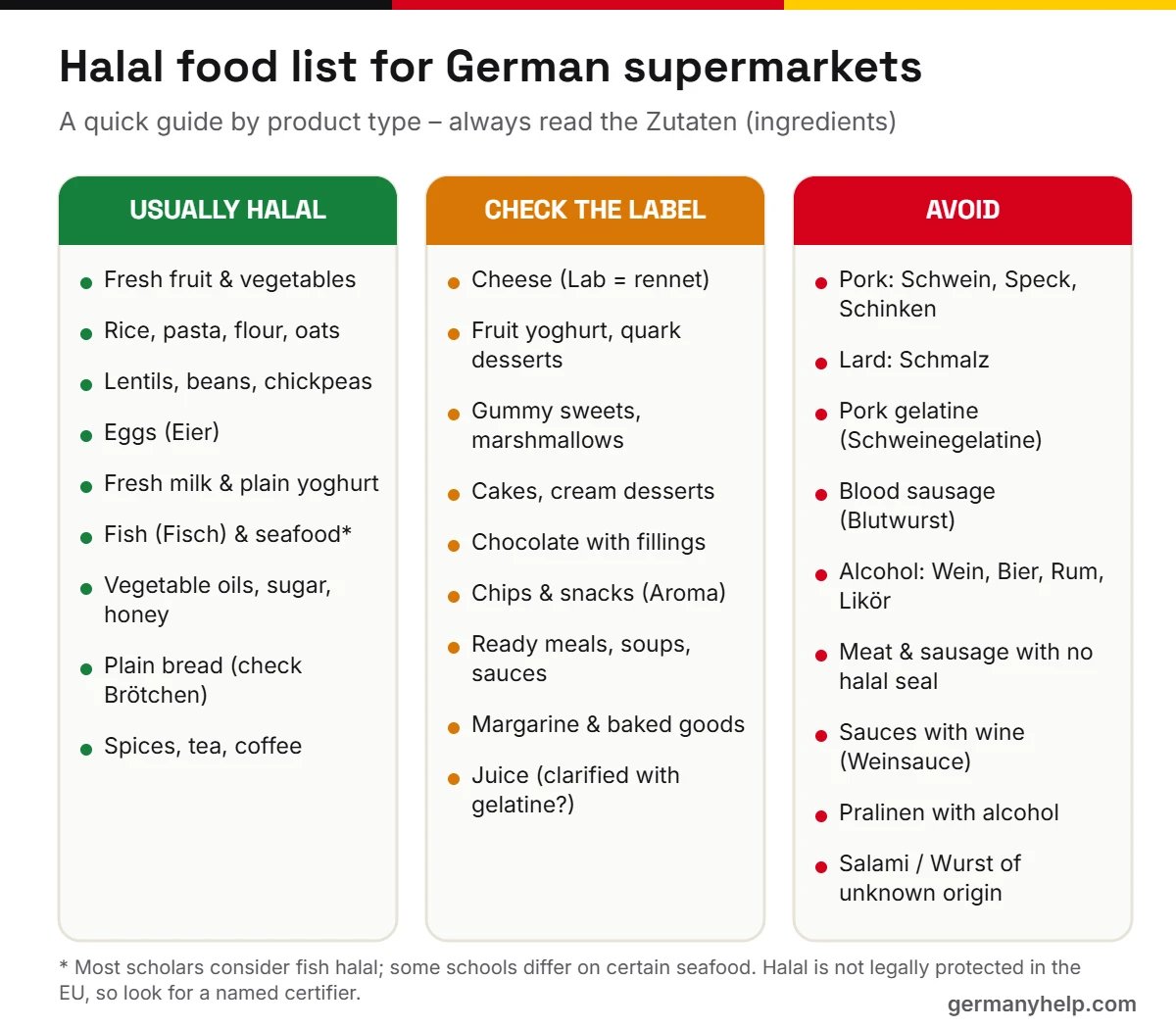
Usually halal – no label check needed
- Fresh fruit and vegetables (Obst und Gemüse), frozen vegetables without sauce
- Rice (Reis), pasta (Nudeln), flour (Mehl), oats (Haferflocken), couscous, bulgur
- Lentils, beans and chickpeas (Linsen, Bohnen, Kichererbsen), dry or canned in water
- Eggs (Eier), fresh milk (Frischmilch), plain natural yoghurt (Naturjoghurt), butter
- Fish (Fisch) – fresh, frozen or canned in oil or water
- Vegetable oils, sugar, honey, salt, plain spices, tea and coffee
- Plain nuts, dates and dried fruit
Check the label first
- Cheese – may contain animal rennet (tierisches Lab). Most Muslims accept cheese with mikrobielles Lab.
- Gummy sweets and marshmallows – most classic gummy bears use pork gelatine.
- Fruit yoghurt, quark desserts, mousse, cream cakes – gelatine is common.
- Chips, crackers and snacks – check the Aroma (flavouring) and any meat-based seasoning.
- Ready meals, soups, sauces, pizza – may contain wine, bacon or pork fat.
- Bread rolls and pastries – usually fine, but some contain lard or the additive E920.
- Juice – some makers clarify juice with gelatine, which many Muslims consider problematic.
Avoid unless certified
- Anything with pork: Schwein, Schweinefleisch, Speck, Schinken, Bacon, Salami (unless the pack says beef/chicken and halal)
- Lard (Schmalz) and pork gelatine (Schweinegelatine)
- Blood sausage (Blutwurst)
- Alcohol: Alkohol, Wein, Bier, Rum, Likör, Weinbrand – also in chocolates (Pralinen) and cakes
- Fresh meat, sausage and cold cuts without a halal seal
Halal food at Aldi, Lidl, Rewe, Edeka and Kaufland
Every big chain sells naturally halal basics. However, certified halal meat and sausage is less consistent: it depends on the branch and the region. In general, you will find more in cities with a large Muslim community. Here is what the chains have said publicly:
| Supermarket | What you can expect |
|---|---|
| Kaufland | Halal products in many branches, often sausage, salami and sucuk at the meat shelf. Kaufland has stated that its Helal/Halal products come from halal slaughter with prior stunning. |
| Aldi Süd | Since September 2025: halal-certified chicken mince (Haltungsform 3, 400 g). Aldi Süd has also tested halal beef sausages and Yayla sucuk in selected regions. |
| Rewe | Halal sucuk and salami from Turkish brands such as Yayla in many stores; halal sweets, cheese and bakery items in some locations. |
| Edeka | Varies by owner-run store; larger Edeka and Marktkauf stores often have a Turkish or international shelf with halal products. |
| Lidl, Penny, Netto | Halal products in individual stores and as occasional special offers; always check the seal on the pack. |
Tip: before you go, use the store’s app or website and search for halal or helal (the Turkish spelling) to see what your local branch stocks.
Halal brands you will see in German supermarkets
- Yayla – Turkish-style sucuk, salami, sausages and yoghurt. The company says all its products are halal-certified. Sold at Rewe, Kaufland, Penny and others.
- Egetürk – one of the biggest halal meat brands in Germany (sucuk, sausages, cold cuts), mainly at Kaufland and Turkish shops.
- Wiesenhof – the biggest German poultry brand has held halal certification for its chicken for years. Still, supermarket packs do not always show the logo. Ask the company if you want confirmation for a specific product.
- Katjes – Katjes makes all its fruit gums and liquorice without animal gelatine. They are not halal-certified, but they are a popular gelatine-free option.
- Haribo – normal German Haribo gummy bears contain pork gelatine. However, Haribo produces a separate halal range in Turkey, which you can find in Turkish supermarkets.
German words to look for on the label
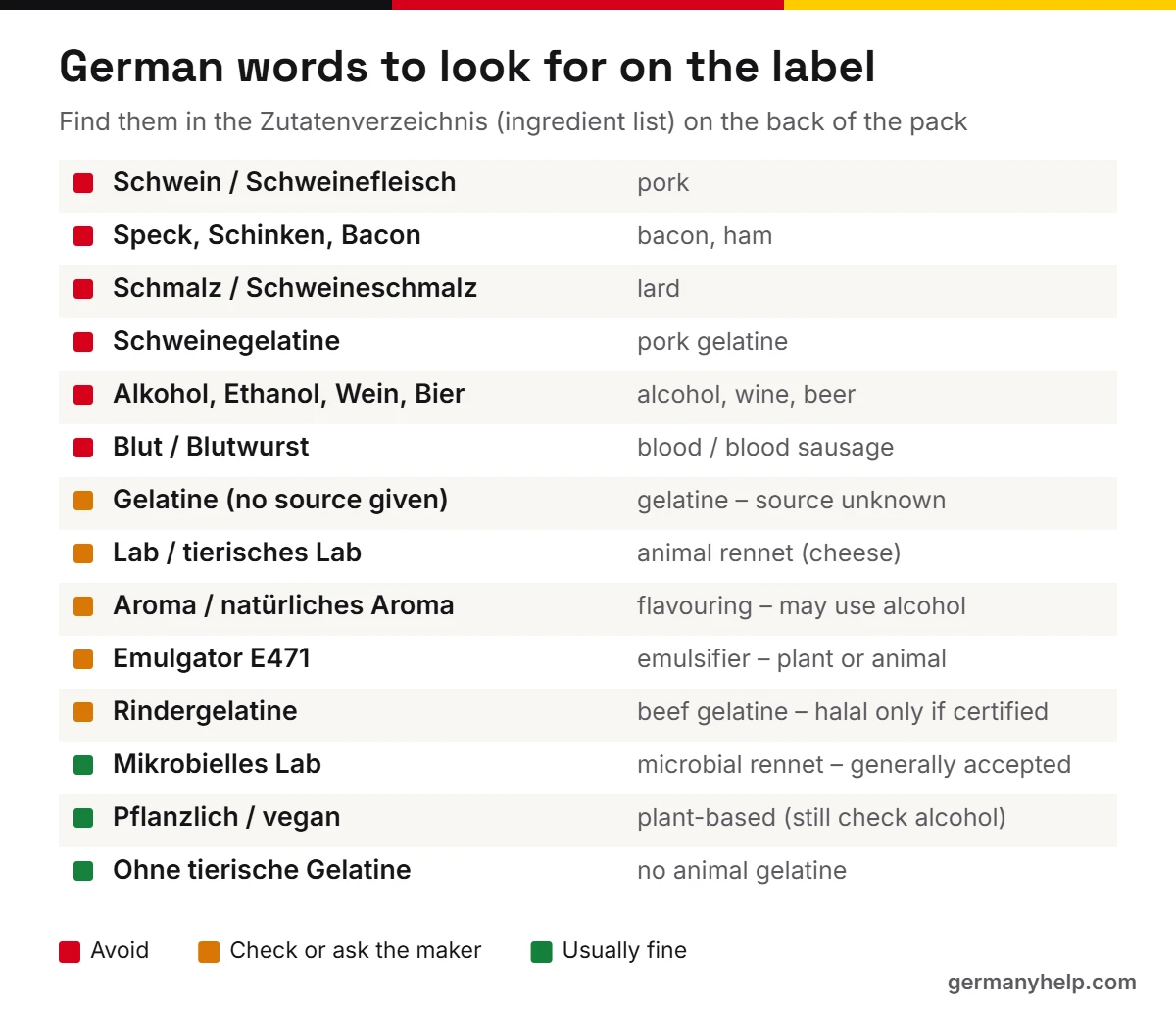
| German word | Meaning | Halal status |
|---|---|---|
| Schwein, Schweinefleisch | pork | Avoid |
| Speck, Schinken | bacon, ham | Avoid |
| Schmalz | lard | Avoid |
| Schweinegelatine | pork gelatine | Avoid |
| Alkohol, Ethanol, Wein, Bier | alcohol, wine, beer | Avoid |
| Gelatine | gelatine (source not stated) | Check – often pork |
| Rindergelatine | beef gelatine | Halal only if certified |
| tierisches Lab / Lab | animal rennet | Opinions differ – check |
| mikrobielles Lab | microbial rennet | Generally accepted |
| Aroma | flavouring | May use alcohol as carrier |
| ohne tierische Gelatine | no animal gelatine | Good sign |
Want to practise these words? In that case, our free German vocabulary flashcards and the phrasebook for students help you read labels and ask staff questions such as „Ist da Schweinefleisch drin?“ (Is there pork in this?).
E-numbers Muslims should check
E-numbers do not tell you the source. In fact, manufacturers can make the same additive from plants, from animals or synthetically. Muslims most often question these:
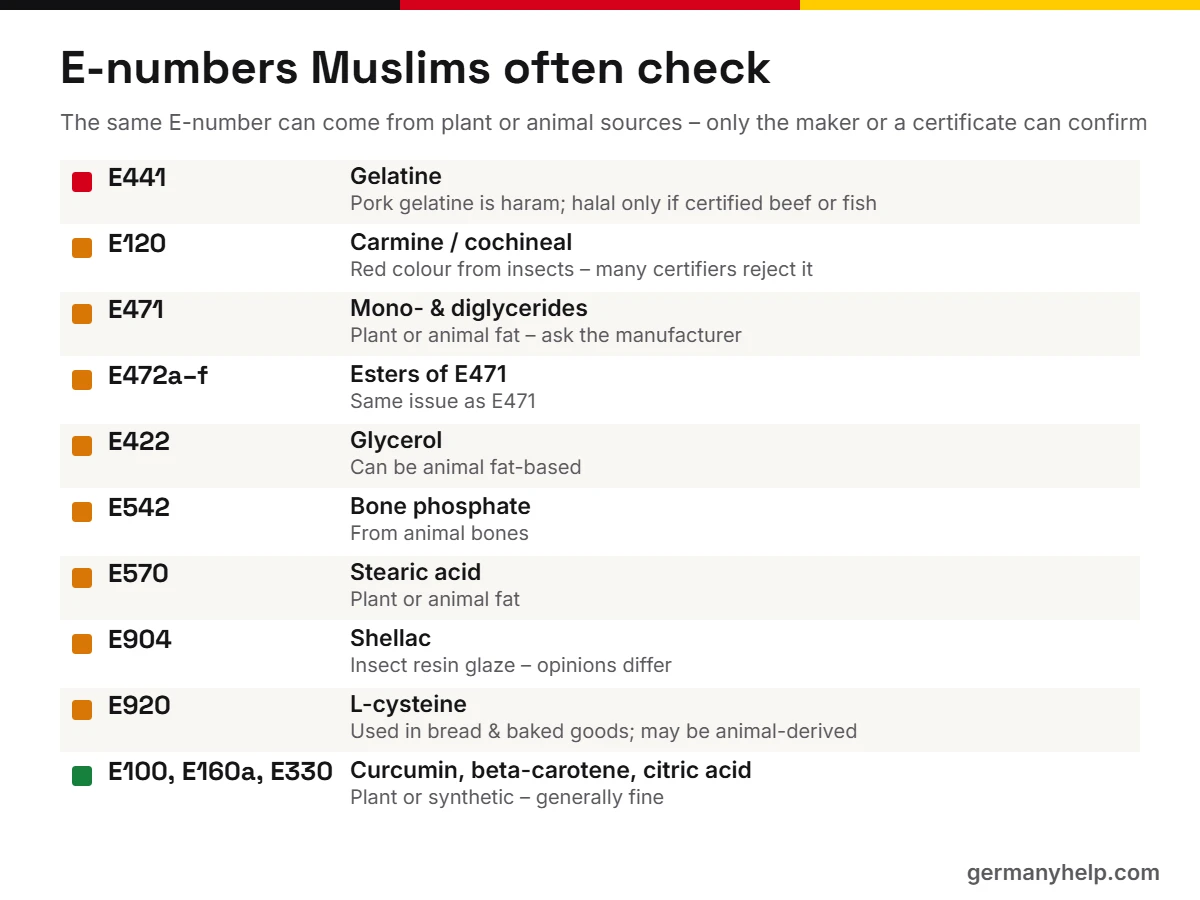
- E441 – gelatine: pork gelatine is haram; beef gelatine is halal only from halal-slaughtered animals.
- E471 / E472 – emulsifiers: made from plant or animal fat. The Verbraucherzentrale offers a template letter so you can ask the manufacturer.
- E120 – carmine: red colouring from insects; rejected by many certifiers.
- E422, E542, E570, E904, E920: can come from animal sources – check or look for a halal seal.
Cheese: the most confusing product
Almost all cheese needs rennet (Lab) to set the milk. Fortunately, many German packs say mikrobielles Lab (microbial rennet), which most Muslims accept. If the pack says only Lab or tierisches Lab, it usually comes from calves. In that case, scholars disagree whether it is permissible when nobody slaughtered the animal the halal way. Meanwhile, producers often make fresh cheeses such as cream cheese, quark or ricotta without rennet. Also, Turkish and Arabic white cheese (Weißkäse) in Kaufland and Turkish shops often carries a halal seal.
Where else to buy halal food in Germany
- Turkish and Arabic supermarkets – the widest choice of certified meat, sucuk, cheese and sweets. Most German cities have several.
- Halal butchers (Helal Kasap) – fresh beef, lamb and chicken; ask which slaughter method they use.
- Asian and South Asian shops – spices, rice, frozen halal chicken and familiar products from home.
- Online halal shops – deliver chilled meat across Germany; check that they name their certifier.
- University Mensa – the menu uses icons for pork, beef, poultry, fish and vegan; ask the staff if unsure.
5 tips for halal grocery shopping as a student in Germany
- Learn the ten label words above – it takes ten minutes and saves you every time.
- Read the certifier’s name, not only the word halal.
- Build your weekly basket around rice, lentils, eggs, vegetables, chicken and fish – they are cheap and halal-friendly.
- Buy meat in bulk from a Turkish shop and freeze it – it is often cheaper than supermarket halal meat.
- When in doubt, choose the vegetarian or vegan version – but still check for alcohol in flavourings.
Moving to Germany soon? Then read our guides on the German blocked account and health insurance and on a Master’s in Computer Science in Germany.
FAQ: halal food in German supermarkets
Is chicken from German supermarkets halal?
Not automatically. Only chicken with a halal seal or from a certified producer is halal. In contrast, normal supermarket chicken follows German animal welfare rules, but no religious requirements.
Are vegan products always halal?
No. Vegan products contain no animal ingredients, but they may contain alcohol, for example in flavourings. In short, vegan is a good starting point, not a guarantee.
Is Haribo halal in Germany?
The normal Haribo products in German supermarkets contain pork gelatine. However, Haribo makes a halal range in Turkey, and Turkish supermarkets sell it.
What does Helal mean on a German product?
Helal is the Turkish spelling of halal. You will see it on many products from Turkish brands.
Which supermarket has the most halal products in Germany?
Kaufland and large Rewe or Edeka stores usually have the most halal meat and sausage. Even so, Turkish and Arabic supermarkets have by far the widest range.
Please note: this guide is general information to help you shop, not a religious ruling. Standards differ between scholars and certifiers. Also, products and recipes change, so always check the current label. Finally, contact the manufacturer or a scholar you trust when in doubt.


Leave a Reply